
Donor retention is one of the most important fundraising metrics a nonprofit can track. It plays a major role in long-term sustainability, donor relationships, and overall revenue growth. Acquiring new donors takes more time and money than keeping existing ones engaged, and supporters who stay involved longer are far more likely to increase their giving over time.
Most nonprofit CRMs make it possible to calculate donor retention at a basic level. But with new tools like DonorSnap Analytics, organizations are no longer limited to a single percentage on a report. Today’s fundraising teams can explore their data in more meaningful ways and use it to guide smarter outreach, better stewardship, and stronger re-engagement strategies.
This article looks at the most important donor retention metrics to track and how DonorSnap Analytics helps nonprofits move from simply measuring retention to actively improving it.
Start Broad and Work Your Way Down
A good place to begin is with your overall donor retention rate. This number gives you a high-level sense of how many donors continue giving from one year to the next. It is a helpful benchmark, but it doesn’t always tell the full story.
An organization may have a stable overall retention rate while still losing donors in specific programs or segments. Broad numbers can hide trends that matter, especially when donor behavior varies by campaign, giving level, or how someone first connected with your organization. Breaking retention into smaller pieces makes it easier to understand what is really happening and where to focus attention.
Narrow Down by Campaign and Appeal
Donor retention is often calculated across all gifts, but this approach can be misleading. Some donors only give to capital campaigns or special initiatives and are not part of an annual giving cycle. If those donors appear as “lapsed,” the data may not reflect their actual intent or loyalty.
Looking at retention by campaign or appeal provides a clearer picture. For example, an annual fund may be losing donors even while a capital campaign remains strong. That insight can help fundraising teams focus their re-engagement efforts where they are truly needed.
Campaign-level retention can also prevent awkward or ineffective outreach. A donor who gives every few years to major projects does not need the same messaging as someone who skipped this year’s annual appeal. Segmenting by campaign allows messages to match donor behavior more closely and feel more personal.
Narrow Down by Giving Level
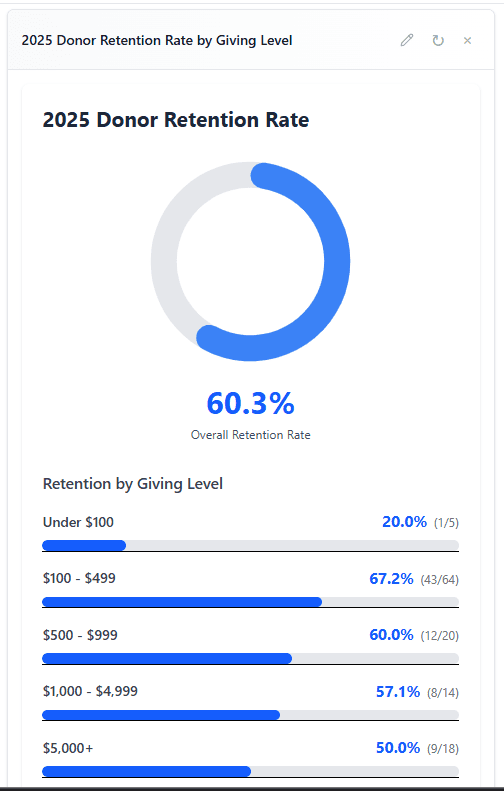
Retention looks different at different giving levels. Smaller donors may lapse more frequently, while mid-level donors may be more consistent but still vulnerable to disengagement if they do not feel appreciated or informed.
When giving levels are analyzed separately, patterns often become clearer. A low retention rate among donors under $100 might suggest that these supporters are not being fully integrated into the organization’s communication and stewardship plans. While individual gifts may be small, the total impact of many small donors is often substantial.
Understanding which giving levels struggle with retention can shape strategy. Some organizations respond by creating more intentional recognition for smaller donors, while others adjust their messaging for mid-level supporters who may be ready to grow in their relationship with the organization.
Look Closely at New Donor Retention
New donor retention is typically lower than retention among repeat donors, which makes it one of the most important metrics to monitor. A first gift is often driven by a single campaign, event, or moment of interest. What happens next determines whether that donor becomes part of the organization’s future or fades away.
Tracking how many first-time donors give again within a year helps reveal how well the organization welcomes and engages new supporters. A steep drop-off may indicate that new donors are not receiving enough follow-up, not hearing about impact, or not feeling personally connected to the mission.
Retention data can also be compared across acquisition methods. Donors who come through events may behave differently than those who give online or respond to appeals. Seeing these differences makes it easier to strengthen onboarding efforts where they are weakest.
Learn more about welcoming and retaining new donors here.
Spot Donors at Risk of Lapsing
One of the most useful shifts in donor retention analysis is moving from reaction to prevention. Instead of waiting until donors have already stopped giving, analytics can highlight changes in behavior that suggest disengagement.
A donor who normally gives every spring but has not yet given this year may be showing early signs of lapse. A supporter who previously made multiple gifts per year but suddenly drops to one may also be losing interest. These patterns can easily go unnoticed without tools designed to surface them.
By identifying these changes early, organizations can respond with thoughtful outreach. A well-timed message that references past support and current impact often feels more relevant and personal than a generic reactivation appeal sent months later.
Turn Retention Data into Strategy
Retention metrics are only useful if they lead to action. When patterns are clear, they can guide decisions about communication, campaigns, and stewardship.
For example:
- If donors who receive regular impact updates stay longer, that insight can shape the organization’s communication calendar.
- If one appeal consistently retains more donors than others, its messaging and timing can inform future campaigns.
- If certain donor groups tend to lapse after their first gift, that segment may need a stronger welcome and follow-up plan.
Over time, these adjustments build a more intentional fundraising strategy that is based on real donor behavior rather than assumptions.
Final Thoughts
Donor retention is more than a statistic on a dashboard. It reflects how well an organization builds relationships and maintains trust with its supporters. Looking only at an overall retention rate can mask important differences across campaigns, giving levels, and donor types.
By starting with a broad view and then drilling down into specific segments, nonprofits can better understand where they are succeeding and where they may be losing ground. With DonorSnap Analytics, retention data becomes more than a measurement tool. It becomes a way to see donor behavior clearly and respond with smarter, more meaningful engagement.
When nonprofits use retention data to guide their outreach and stewardship strategies, they are not just tracking donors. They are strengthening the relationships that make long-term fundraising possible.