Strategic planning can feel like a big undertaking, especially for small and mid-sized nonprofits where staff wear multiple hats and time is limited. But a solid strategic plan does not have to be complicated. What it does need is grounding in real data. The good news? If you have been using a donor management system, you already have a wealth of information that can guide your planning process. Here is how to put it to work.
Why Should Your Nonprofit Have a Strategic Plan?
A strategic plan is more than an internal management tool. It is one of the most effective ways to communicate your organization’s direction, priorities, and intentions to the people who matter most: your donors, board members, volunteers, grant funders, and the communities you serve.
When stakeholders can see exactly where your organization is headed and how you plan to get there, it builds confidence. Donors feel more assured that their gifts are being put toward a thoughtful, well-managed mission. Board members can make decisions aligned with a shared vision rather than debating direction at every meeting. Grant funders, many of whom require a strategic plan as part of the application process, can evaluate your organization’s readiness and capacity with confidence.
Beyond external trust, a strategic plan creates internal alignment. It gives your staff and volunteers a shared sense of purpose and helps everyone prioritize the right work. Without one, it is easy for organizations to drift, chase every new opportunity, or lose momentum when leadership changes.
In short, a strategic plan signals that your organization is serious, stable, and worthy of long-term investment.
What Is a Strategic Plan?
A strategic plan is a roadmap that outlines where your organization wants to go and how it plans to get there. It typically defines your mission focus, long-term goals, and the specific objectives and actions that will move you toward those goals.
For nonprofits, a strategic plan often addresses areas like fundraising growth, program expansion, community impact, operational sustainability, and donor retention. It gives your board, staff, and volunteers a shared sense of direction and helps you make decisions with purpose rather than reacting to whatever comes up.
Think of it as the difference between running a race with a route planned in advance and simply running until you are tired.
How Long Should a Nonprofit Strategic Plan Span?
Most nonprofit strategic plans cover a three- to five-year window. Three years is often a good fit for smaller or newer organizations, or those navigating a period of transition, since it allows for flexibility without losing sight of the bigger picture. Five-year plans work well for organizations with stable funding, established programs, and a clear long-term vision.
Regardless of the timeframe you choose, plan to revisit and review your strategic plan annually. Circumstances change, funding landscapes shift, and the goals you set today may need to be adjusted as you learn more. A strategic plan should be a living document, not something that gets filed away after your board retreat.
What to Include in a Nonprofit Strategic Plan
While every organization’s plan will look a little different, most strong strategic plans include:
Mission, vision, and values. Reaffirm the why behind your work. This keeps everything else anchored.
An environmental scan. A brief look at where your organization stands today, including strengths, challenges, opportunities, and external factors that may affect your work. This is sometimes called a SWOT analysis.
Strategic priorities. The two to four big areas your organization will focus on during the plan period. These might include expanding a program, diversifying revenue, building board capacity, or deepening donor engagement.
Goals and objectives. For each strategic priority, outline specific goals (what you want to achieve) and the measurable objectives that will mark your progress.
Fundraising targets. Realistic revenue goals tied to your programs and operations, informed by your historical giving data.
An evaluation framework. How will you know if you are on track? Define the metrics you will use to measure progress and how often you will review them.
What Metrics Should You Include?
Your strategic plan should be built on metrics that actually reflect organizational health, not just the numbers that are easiest to pull. Here are some key areas to consider:
Donor retention rate. What percentage of donors who gave last year gave again this year? Retention is one of the strongest indicators of long-term sustainability. Industry-wide, nonprofit donor retention tends to hover around 40-45%, so knowing where you stand gives you important context.
Average gift size. Tracking this over time helps you understand whether your donor base is growing in value, not just volume.
LYBUNT and SYBUNT count. Understanding how many donors gave last year but not this year (LYBUNT) or some year but not this year (SYBUNT) helps you identify where you are losing donors and plan targeted re-engagement efforts.
Total revenue by fund or campaign. Breaking down revenue by funding source helps you understand what is driving growth and where you may be over-reliant on a single stream.
Major gift pipeline. How many donors are giving at or above a threshold that you consider major? Are those numbers growing?
New donor acquisition. How many new donors did you bring in, and at what cost? This helps you evaluate the return on your outreach efforts.
Pledge fulfillment rate. If your organization collects pledges, tracking how reliably those commitments convert to actual gifts is essential for accurate revenue forecasting.
Event and campaign performance. For organizations using EventSnap or AuctionSnap, revenue per event and year-over-year comparisons give you a clear picture of how your fundraising events are trending.
How Can You Accurately Forecast These Metrics?
Forecasting can’t predicting the future perfectly. But it can help you make informed, reasonable projections based on what your data actually shows.
Start with at least two to three years of historical data if you have it. Look for patterns: Does giving spike in December? Do you typically see a drop-off in donor retention after a major event year? Are new donor numbers climbing or flat? Trends in your past data are usually the most reliable indicator of what is ahead.
From there, layer in context. Are you planning a major campaign or event that could drive acquisition? Have you recently lost a major foundation grant that will affect revenue? Are there economic conditions in your region that might affect giving? Honest answers to these questions help you build projections that are useful rather than just optimistic.
A few practical tips:
- Build a conservative forecast and a growth forecast. Planning for a range rather than a single number gives your board room to make decisions based on different scenarios.
- Update your projections regularly. If you review actuals against projections quarterly, you can catch problems early and adjust before they become crises.
- Do not overlook donor segmentation. Projecting aggregate totals is useful, but understanding how different segments of your donor base are likely to behave gives you much more actionable insight.
How Can DonorSnap Analytics Help?
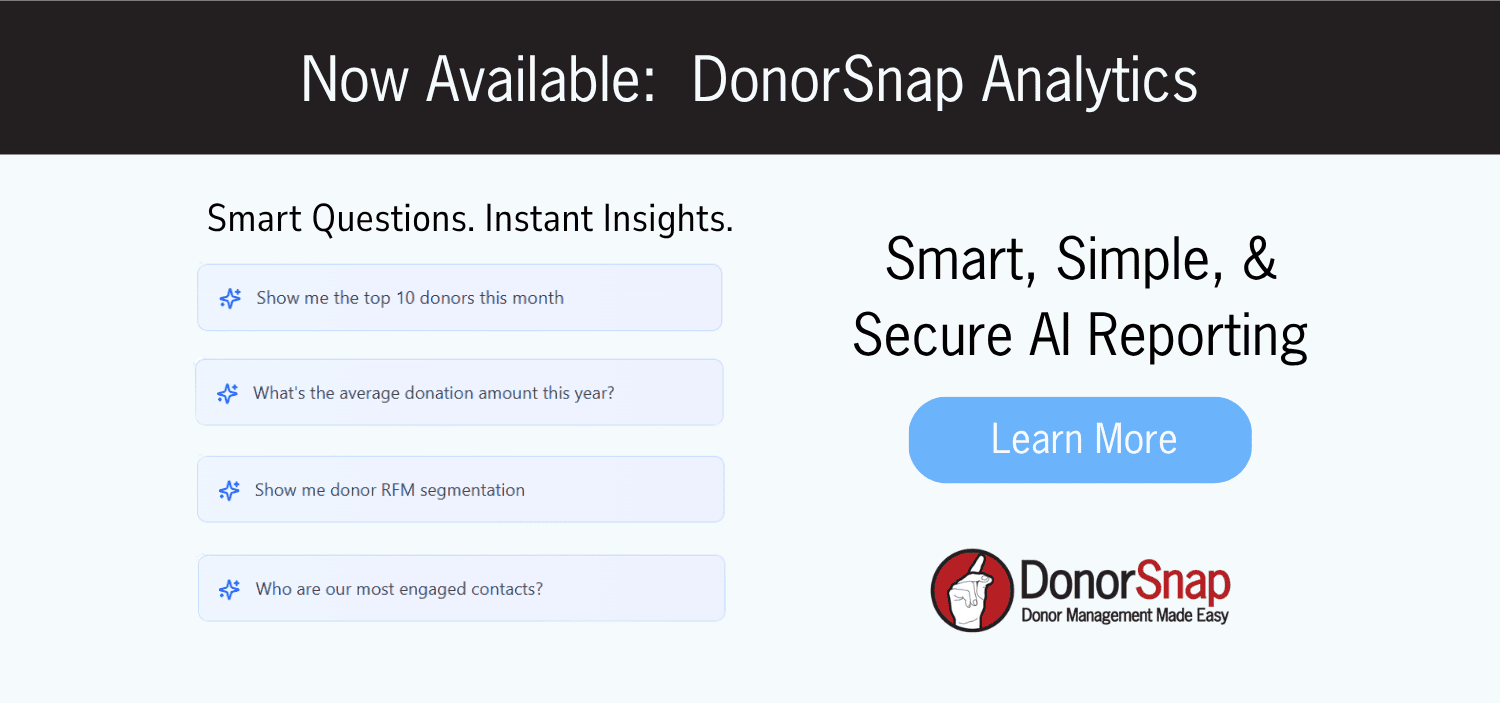
Pulling all of this data together manually is time-consuming, and for a busy nonprofit team, time is rarely in surplus. That is where DonorSnap Analytics comes in.
DonorSnap Analytics is an AI-powered reporting tool built directly into DonorSnap that allows you to generate reports using plain-language prompts, without needing to know how to write a query or navigate complex report builders. You can ask for a summary of donor retention trends, pull a LYBUNT list for a specific date range, or see how average gift size has shifted over the past three years, all in a fraction of the time it would take to build those reports from scratch.
One important note worth sharing with your team: DonorSnap Analytics is designed with data security in mind. The AI only sees field names and structures, not individual donor data, so your constituent information stays protected.
For strategic planning specifically, DonorSnap Analytics can help you quickly surface the historical trends you need to build accurate forecasts, pull donor retention, giving totals, and segmentation data without spending hours in report setup, identify patterns in your data that might not be obvious at a glance, and come to board meetings and planning sessions with numbers you can stand behind.
At $12 per month, it is one of the most accessible ways to bring data-informed decision-making into your planning process, regardless of the size of your team or your technical comfort level.
Where to Share Your Strategic Plan
Once your plan is finalized, do not let it sit in a folder. Sharing it widely reinforces transparency and keeps your community engaged in your mission.
A few places to consider:
Your website. Post a summary version or a downloadable PDF on your About or Governance page. This is especially important for grant funders and major donors who may research your organization before giving.
Donor communications. Reference your strategic priorities in your newsletters, appeal letters, and year-end reports. Connecting your fundraising asks to a bigger plan gives donors a compelling reason to invest.
Board and volunteer meetings. Keep the plan visible at every meeting. Use it as a touchstone when setting agendas and evaluating new initiatives.
Events. Print a one-page summary to display or distribute at your fundraising events, galas, or community gatherings. A well-designed flyer or table card with your key goals and vision makes your organization look polished and purposeful, and gives attendees something to take home.
Grant applications. Many funders ask for your strategic plan directly. Having one ready, and one that is clearly tied to your data and outcomes, strengthens every application you submit.
The more visible your plan is, the more accountability you create, and the more trust you build with every audience that cares about your work.
Start Where You Are
You do not need a perfect dataset or a dedicated data analyst to build a strategic plan grounded in your organization’s actual performance. Start with what you have, focus on the metrics that matter most to your mission, and commit to reviewing your progress consistently.
Your data tells a story. A strategic plan helps you decide what happens in the next chapter.
Want to see how DonorSnap Analytics can support your planning process? If you are a current DonorSnap user, email [email protected] to see about adding DonorSnap analtyics to your account.
New to DonorSnap? Sign up for a demo here.