You write the appeals, pull the reports, manage the donor database, coordinate with the board, plan the events, send the thank-you letters, and somehow also find time to actually cultivate donor relationships.
If you have a good week, everything gets done. If you have a bad one, the thank-you letters pile up, a lapsed donor slips through unnoticed, and you end the day wondering whether any of it moved the needle.
This is the reality for most small nonprofits. There is no development department. There is one person, and the job of three people lands on their desk every morning. Research from the Center for Effective Philanthropy found that 95% of nonprofit leaders are concerned about staff burnout, with nearly 50% finding it difficult to fill open positions. Nonprofit Quarterly
This guide is not going to tell you to set better boundaries or practice self-care. It is going to give you a practical framework for working smarter inside the constraints you actually have.
Sort your work into three buckets
The first trap most solo fundraisers fall into is treating everything on their list as equally urgent. The truth is not all tasks create equal value, and knowing the difference is the foundation of everything else.
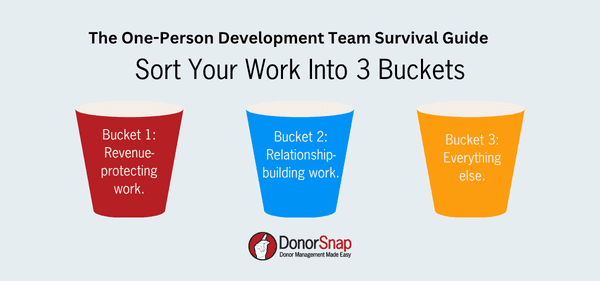
Bucket 1: Revenue-protecting work.
Tasks where dropping the ball has a direct financial consequence. Donor acknowledgments, your automated welcome series, lapsed donor outreach, year-end appeals. These are not optional. Only 19.4% of first-time donors give a second gift, meaning 4 out of 5 first-time donors never come back. A prompt, warm thank-you after a first gift is one of the most impactful things you can do to change that.
Bucket 2: Relationship-building work.
Individual donor meetings, personal calls to major gift prospects, handwritten notes, board cultivation. None of this produces immediate revenue, but the organizations that consistently skip it watch their major donors drift away. Protect at least a small amount of time for this every week, even when it does not feel urgent.
Bucket 3: Everything else.
Social media posts, database cleanup, formatting newsletters, event logistics. These matter, but they get done last, batched efficiently, or delegated.
When you are overwhelmed, go back to the buckets. Do bucket one first. Always.
Build your automation before you need it
The single highest-leverage investment a solo fundraiser can make is setting up automated email sequences before a campaign begins, not after. The extra work upfront saves you from doing manual follow-up at the exact moment you are most exhausted.
Here is the minimum viable automation for a small shop:
New donor welcome series. When someone makes their first gift, they should automatically receive at least two follow-up emails in the first 30 days beyond their initial receipt. The first, sent a few days after the gift, should be personal and focused entirely on impact. The second, around the 3 to 4 week mark, should introduce them more fully to your work and offer a soft invitation to engage further.
Lapsed donor sequence. Any donor who has not given in 13 to 15 months should automatically enter a re-engagement sequence. A two or three email series acknowledging their previous support, sharing an impact update, and making a soft ask will recover a percentage of lapsed donors without you lifting a finger once it is built.
Year-end acknowledgment template. Finish this in October, before things get chaotic. When gifts roll in during November and December you want to be processing acknowledgments from a finished template, not writing them under pressure.
In DonorSnap, the Automated Task Manager handles date-triggered sequences so these workflows run on their own once you have set them up. The time you invest building them in September pays back every day in the fourth quarter.
Guard your data like infrastructure
Your donor database is not an administrative task. It is the infrastructure your entire operation runs on. A clean, well-maintained database means accurate reports, confident decisions, and donors who never fall through the cracks. A messy one means you are flying blind.
A few habits that make a meaningful difference:
- Enter gifts the same day they arrive. Letting gifts pile up for a week means thank-yous go out late, which directly affects retention.
- Code every gift consistently. Campaign code, appeal code, every time. If you skip this step when you are busy, you will not be able to pull meaningful reports on what worked.
- Run your LYBUNT report quarterly, not just at year-end. Lapsed donor outreach is most effective before a donor has been gone too long. If you only check in November, you have already lost a year with donors who stopped giving in January.
- Do your NCOA cleaning annually. DonorSnap subscribers have access to a free National Change of Address cleaning every year. Use it. A returned mailing is a missed touchpoint.
Know your three most important numbers
There are dozens of metrics you could track. For a team of one, tracking dozens of things means tracking nothing well. Pick three numbers and know them cold.
Donor retention rate.
Overall donor retention rates hover between 40 and 45% across the nonprofit sector, and acquiring a new donor costs up to five times more than retaining an existing one. Your retention rate tells you whether your stewardship is working. If it is dropping, something in your communication cycle needs attention. NextAfter
Average gift by segment.
Not overall average — by segment. What is your average gift from donors who have given three or more times? From first-time donors? From event attendees? These numbers tell you where your best donors are coming from and where to invest your cultivation time.
Upgrade rate.
What percentage of donors increased their gift compared to last year? Most small nonprofits focus heavily on acquisition and retention and almost never think about upgrading existing donors. A mid-level donor who gives $250 a year and has never been asked for more is a major gift waiting to happen.
Run these three numbers at the start of every quarter. It takes about 20 minutes to run numbers and will tell you more about the health of your program than any amount of activity tracking.
Your tools should work together
One of the quietest time-thieves in a solo development operation is toggling between disconnected systems. You pull a donor report from one place, cross-reference event attendance from another, try to note who attended your auction, and synthesize all of it before writing a single cultivation email. By the time you sit down to write, 40 minutes are gone.
The antidote is not more tools. It is fewer tools that are actually connected.
DonorSnap as your hub.
Your donor database is not just where you store contact information. It is where giving history, communication preferences, segmentation, and relationship notes all live together. Every other tool in your stack should feed back into it. When it does, you have a single source of truth for every donor relationship.
EventSnap for ticketing and registration.
The people who attend your events are often your most engaged supporters. EventSnap handles ticket sales and registration, and because it is built to work alongside DonorSnap, your attendee data does not stay siloed. You can see event attendance directly on a donor’s record and use it to inform cultivation and follow-up. A donor who has attended your gala three years in a row is telling you something about their commitment. Your database should reflect that.
AuctionSnap for auction fundraisers.
Silent and live auctions are among the most relationship-rich events a small nonprofit can run. AuctionSnap manages the auction experience and pulls your guest list directly from DonorSnap, so you are not rebuilding records from scratch each time. After the event, participation data lives where it belongs: on the donor’s record, informing every conversation you have with them going forward.
The practical result of running these tools together is that you stop doing things twice. Guest lists do not need to be exported and re-imported. Attendance does not need to be logged manually. Your post-event follow-up list comes from a system that already knows who was there, what they bid, and what they have given before. For a team of one, that is not a nice-to-have. That is how you protect your time.
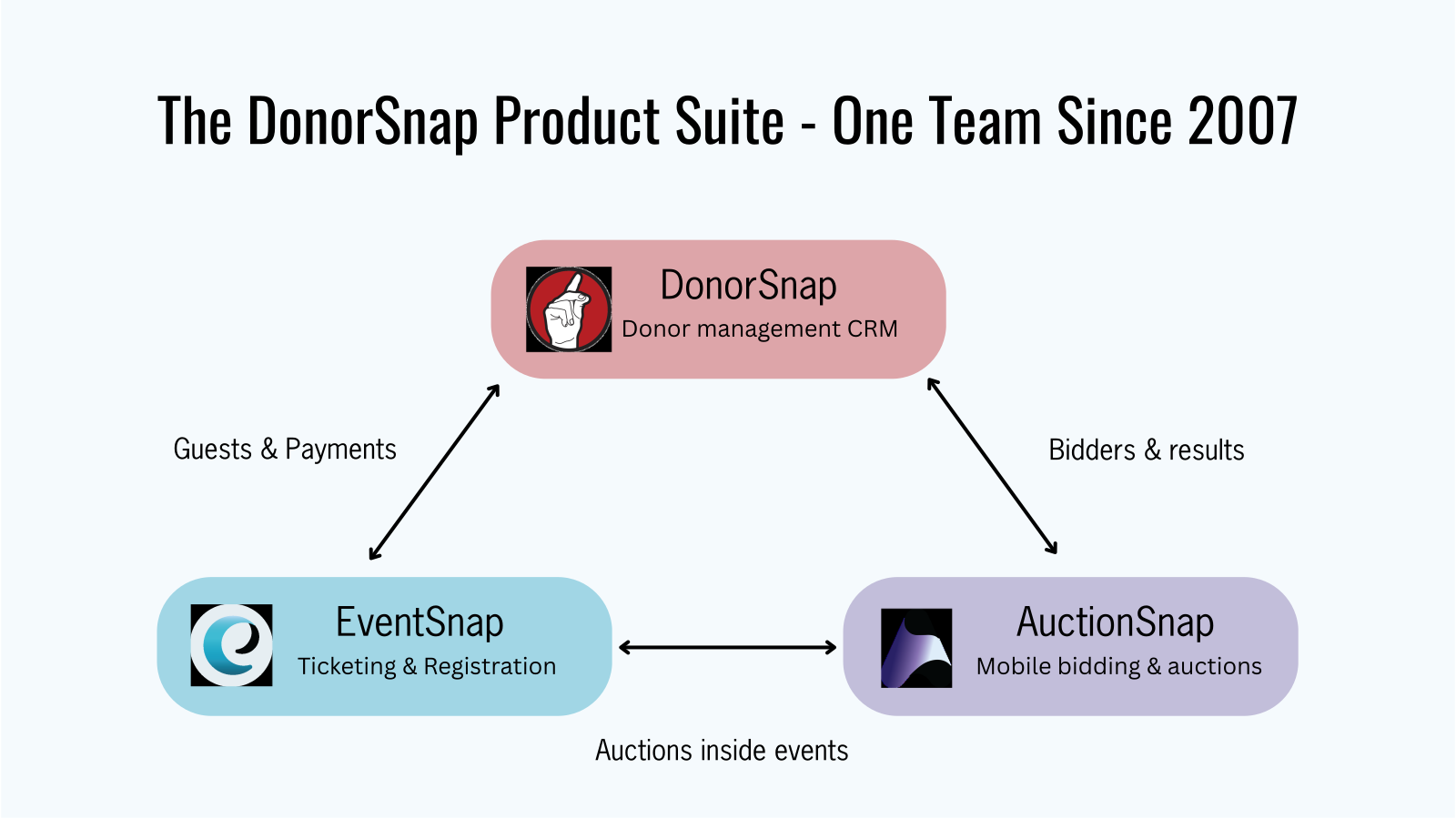
Learn more about the DonorSnap product suite here.
Let your tools do the analysis
There is a version of being a solo fundraiser where most of your analysis time goes toward pulling reports, exporting to spreadsheets, adding columns, cross-referencing, and building something that resembles an insight. Then you do it again next quarter.
DonorSnap Analytics is an AI-powered reporting add-on that lets you ask questions about your donor data in plain English. Instead of spending 30 minutes building a custom query, you ask something like “Which donors gave last year but not this year and have a giving history of more than three gifts?” and you get the list.
For a one-person development team, that changes what is actually possible in a workday. The kinds of questions it answers quickly:
- Who are my most at-risk donors right now?
- Which donors have increased their giving consistently year over year?
- Who attended my last event but has never made a donation?
- Which appeals get the best response from mid-level donors?
These are questions a solo fundraiser might mean to answer every quarter but never quite gets to because pulling the underlying data takes too long. Analytics makes the asking fast enough that it actually happens, which means you make decisions based on current information rather than general intuition.
At $12 per month, it is also designed for organizations where every budget line needs to earn its place.
Use your board as fundraising partners
Your board members are your single greatest underutilized asset for donor cultivation. Most of them do not know how to help, or feel uncomfortable with anything that resembles asking for money. Your job is to make it easy to participate without putting them in uncomfortable positions.
Here is what that looks like practically:
Give board members a short thank-you list each quarter.
Not to ask for money. Just to personally call or email a handful of donors and share a brief impact update. A board member calling a donor to say “I just wanted you to know what your gift made possible” is one of the most effective stewardship moves a small nonprofit can make.
Ask them to open doors, not close gifts.
If a board member knows someone who might be interested in your work, they can make an introduction. You handle the relationship from there. Removing the ask from the equation makes most board members significantly more willing to participate.
Send a simple board report.
One that takes you 20 minutes to produce. Your three key metrics plus a brief narrative update. Board members who feel informed about fundraising progress are more likely to be engaged in fundraising activity.
Batch your work ruthlessly
Context switching is expensive. Moving from writing an appeal to answering a board email to updating a donor record to pulling a report means you are never fully focused on any of it, and everything takes longer than it should.
You do not have to batch everything. You just have to stop treating your calendar as a free-for-all.
A few batching moves that work well for small development shops:
- Set one day or morning per week as your database day. All gift entry, acknowledgment processing, and list pulls happen then. The rest of the week you are not touching the database for administrative tasks.
- Write all donor-facing content in one session per month. Appeals, emails, social posts. Content creation requires a different mental mode than logistics. Writing in 20-minute windows between other tasks is how you end up with appeals that feel flat.
- Handle board communication in one weekly update rather than responding to individual questions throughout the week.
Even rough batching makes you meaningfully more productive by reducing the overhead of constant switching.
Document what only you know
One of the risks of being the only person who knows everything is that when you leave, and everyone eventually leaves, institutional knowledge walks out the door with you.
At minimum, keep a shared document that covers:
- How gifts are entered and coded
- How acknowledgment letters are generated and sent
- What your automated sequences are and when they trigger
- What your annual calendar looks like for appeals, events, and reporting
This does not need to be elaborate. A Google Doc you update when processes change is enough. The organization you protect when you document your work is not just the one that would survive after you leave. It is also the one that can survive when you take a vacation, get sick, or have a month where everything goes sideways.
The right CRM makes all of this possible
Everything in this guide assumes you have a place where donor data lives that is accurate, searchable, and connected to your communications. If you are still running your development operation on a spreadsheet or a generic contact tool, no amount of batching and automation strategy will get you where you need to go.
A purpose-built nonprofit CRM gives you things a spreadsheet simply cannot:
| What you need | What a nonprofit CRM delivers |
| Giving history alongside relationship history | One record per donor with full communication and gift log |
| Automated acknowledgments and sequences | Triggered emails without manual follow-up |
| Segmented lists in minutes | Filter by any field — gift size, lapsed status, event attendance |
| Board-ready reports | Pre-built reports you can run in a few clicks |
| Data that informs decisions | Trends, retention rates, upgrade opportunities |
DonorSnap is built specifically for organizations like yours — small teams with real fundraising goals and no time to waste on software that requires a consultant to configure. Starting at $50 per month, it includes unlimited users, built-in online forms, email and text capabilities, the Automated Task Manager, and reporting tools designed for how nonprofits actually work. Add EventSnap and AuctionSnap when you are ready to bring your events into the same system, and DonorSnap Analytics when you want to ask questions of your data without building queries.
If you are evaluating your options, the questions worth asking of any CRM are straightforward: Can one person learn it without dedicated IT support? Does it handle acknowledgments, segmentation, and reporting natively without requiring add-ons? Can it grow with you without repricing every time your donor count increases? For a solo fundraiser, the answers to those questions matter more than any feature list.
Give yourself permission to have a short list
The most liberating thing many solo fundraisers discover is that doing fewer things consistently is more effective than doing many things inconsistently.
You do not need a 12-touch annual communication plan. You need a realistic one you will actually execute.
For most small organizations, that looks like a spring appeal, a summer impact update, a fall campaign or event, and a year-end appeal — with automated acknowledgments and a welcome series running in the background throughout the year. That is eight to ten touchpoints for an active donor. It is manageable. It is enough.
The goal is not to do more. It is to do the right things well, protect your highest-value tasks from being crowded out by urgent but lower-value ones, and build enough automation that your program does not depend entirely on you being at full capacity every day.
You are one person doing the work of several. That deserves acknowledgement. And you can do it well.
DonorSnap is designed for development teams of every size, including teams of one. From automated acknowledgment letters to lapsed donor reports to AI-powered analytics, every tool in the system is built to reduce the administrative load and keep you focused on your donors. [Schedule a free demo] to see how it works.